

A Life Changing Target is the defining four-year business outcome a founder uses to turn ambition into measurable decisions about growth, capital, customers, leadership, and enterprise value.
· A Life Changing Target is not just a revenue goal. It is the strategic outcome a founder is building toward.
· The target matters because founder-led companies need a clear destination before they can make disciplined decisions about capital, customers, hiring, partnerships, and market expansion.
· U.S. small businesses matter enormously to the economy, but durable growth is difficult and true high-growth companies are relatively rare. [SBA 2026] [BLS 2024] [Census BDS-HG]
· Next Stage Trajectory uses the Life Changing Target to help founders move from broad ambition to a structured next-stage journey.
· The purpose is not to dream bigger. The purpose is to make the founder’s ambition concrete enough to guide action.
Why Founder Goals Are Often Too Small for the Job
Most founders have goals. They want more revenue, stronger margins, better customers, a larger team, greater enterprise value, more freedom, or a successful exit. Those goals matter, but they often remain too general to govern the business.
That is the problem.
A founder-led company does not only need something to aim at. It needs a target strong enough to shape choices. Which customers should the company pursue? Which opportunities should it decline? Should it raise capital or grow through retained earnings? Should the founder hire ahead of demand or protect cash? Should the company expand into a new market, productize part of the offer, or narrow its focus?
These decisions cannot be answered well by ambition alone. They require a destination.
That is what Next Stage Trajectory means by a Life Changing Target.
The Life Changing Target is not a slogan, a motivational exercise, or a bigger number placed on a planning sheet. It is the organizing decision that defines what the founder is building toward and what must be true along the way.
Why This Matters Now
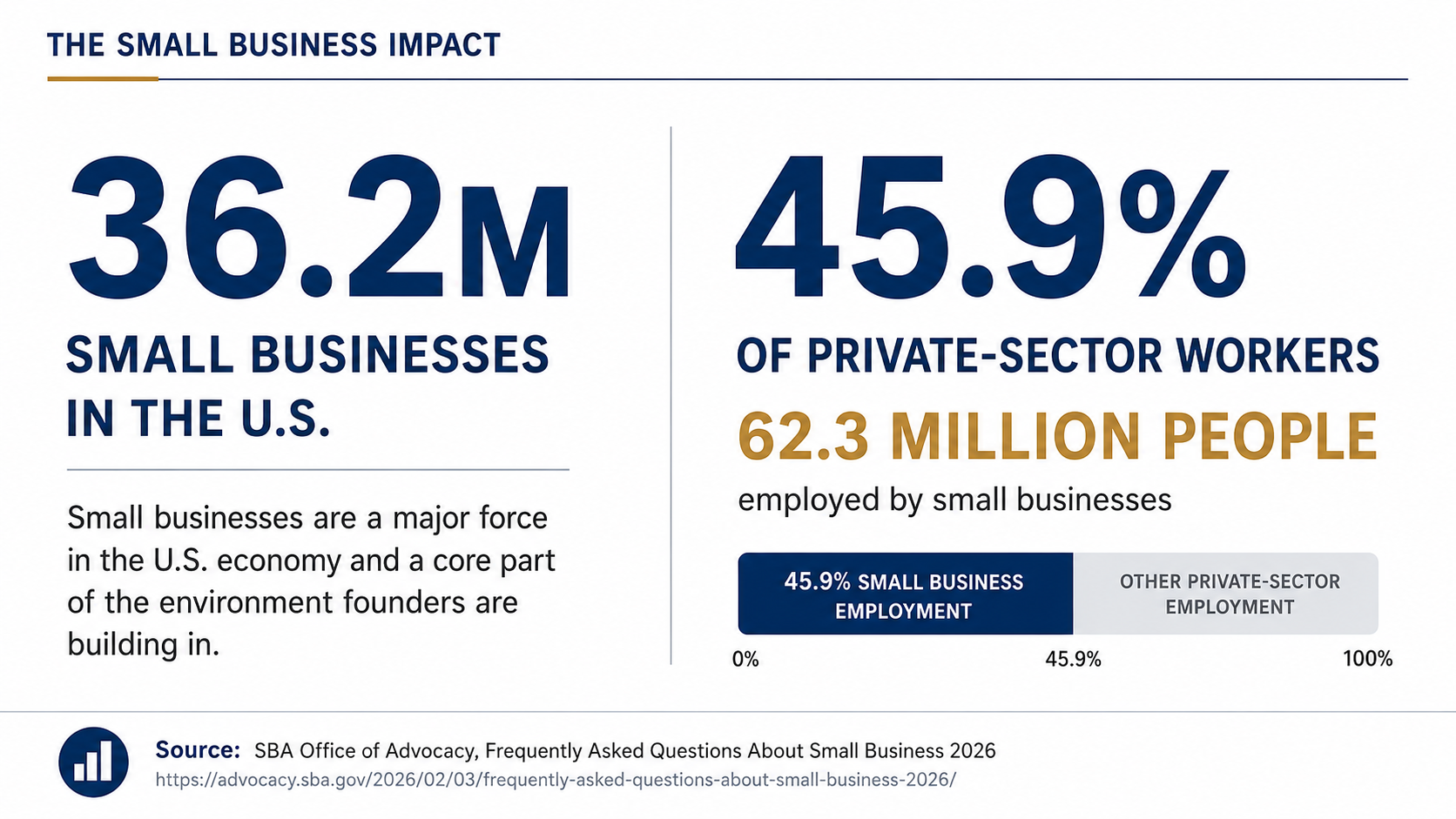
The need for disciplined founder targeting is not theoretical. Small businesses remain central to the U.S. economy. The SBA Office of Advocacy reported in 2026 that there are more than 36 million small businesses in the United States, employing 62.3 million people, or 45.9% of private-sector workers. Small businesses also account for 43.5% of U.S. GDP. [SBA 2026]
That makes founder-led business growth a serious economic matter, not a niche entrepreneurial concern.
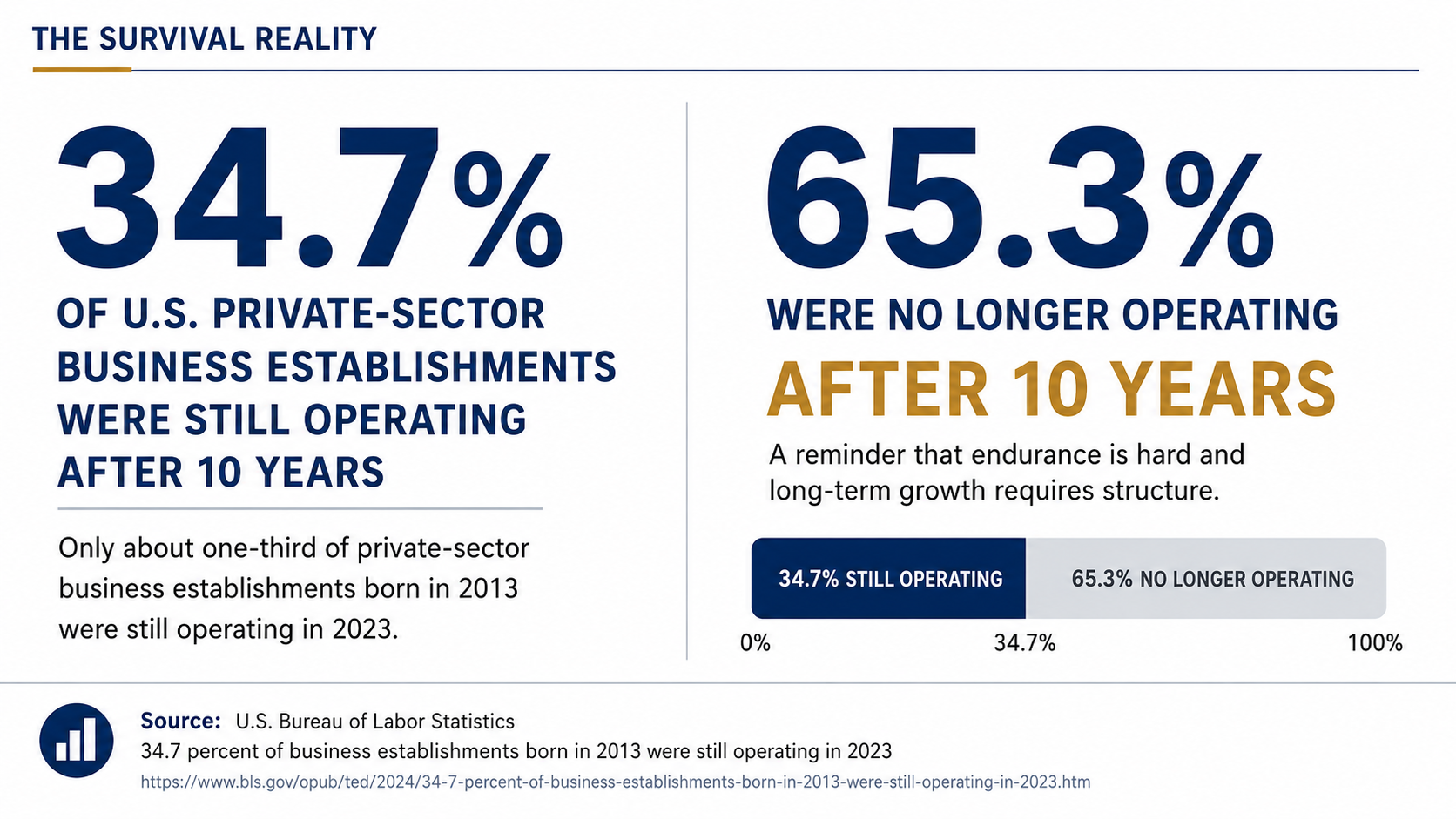
But endurance and scale are difficult. The U.S. Bureau of Labor Statistics reported that only 34.7% of U.S. private-sector business establishments born in March 2013 were still operating in March 2023. [BLS 2024] Survival alone is hard. Sustained growth is harder.
The Federal Reserve’s 2026 Small Business Credit Survey found that revenue and employment growth remained stable among small employer firms, but expectations for future revenue and employment growth declined to their lowest levels since the 2020 survey. The same report identified reaching customers and growing sales as the most commonly reported operational challenge. Rising costs were the most common financial challenge. [Fed SBCS 2026]
For founders, those conditions raise the stakes. A vague goal is not enough when customers are harder to reach, costs are rising, capital decisions are more consequential, and growth expectations are becoming more cautious.
The company needs a target that can discipline the journey.
What a Life Changing Target Actually Is
A Life Changing Target is the meaningful business outcome a founder wants to reach over a defined time horizon, typically four years.
That outcome may include a revenue number. But it should not stop there.
A founder may want to build toward a company that reaches $10 million in revenue, becomes attractive to investors, enters the U.S. market, creates a path to exit, supports financial independence, or becomes less dependent on the founder’s daily involvement. In each case, the number matters because of what it makes possible.
Bill Weathersby, Founder and Chairman of Next Stage Trajectory, described this idea in his recent Business Tycoon Magazine feature. The article positioned NST around helping founders in the complex middle after early traction, where the company has potential but needs more structure, guidance, accountability, and access. It also described the Life Changing Target as a method for defining the founder’s meaningful four-year outcome and then working backward into thirty-six-month, twenty-four-month, twelve-month, and immediate priorities. [Business Tycoon 2026]
That backward movement is what makes the concept practical.
The Life Changing Target begins in the future, but its value is in the decisions it changes today.
A Target Is Different From a Wish
Many companies set targets that sound serious but do not influence behavior. The leadership team says it wants to double revenue, enter a new market, attract capital, or prepare for exit. Then the business continues making decisions the same way it did before.
That is not a target. That is a wish with a number attached.
A true Life Changing Target should create tension. It should force the founder and team to ask whether the current company is actually built for the future company they claim to want.
Is the customer base right for that target? Is the value proposition strong enough? Does the business model support the desired scale? Will the margins hold? Can the founder remain the primary sales engine? Is the leadership team ready? Does the company need capital, and if so, what would that capital unlock? What proof would investors, partners, or senior hires need to believe the trajectory?
These are the questions that separate a useful target from a decorative one.
Why Four Years Is a Useful Horizon
A one-year goal is often too tactical. It can become a budget exercise, a sales target, or a list of projects.
A ten-year vision can become too distant. It may inspire, but it often lacks operational pressure.
Four years sits in the useful middle. It gives the founder enough time to create a meaningful change in the business, but not so much time that accountability disappears. It allows for ambition, but it also requires milestones.
That matters because high-growth companies are not the norm. The U.S. Census Bureau’s experimental Business Dynamics Statistics of High Growth Firms reports that the share of high-growth firms fell from just under 20% in 1978 to less than 13% in 2020. The share of high-growth continuing firms fell from 4.8% to 2% over the same period. [Census BDS-HG]
In other words, the journey from operating business to high-growth business is uncommon. Founders should treat it as a designed trajectory, not an accidental outcome.
A four-year Life Changing Target helps create that design.
What the Life Changing Target Changes
The power of the Life Changing Target is not that it gives the founder a more impressive goal. Its power is that it changes the decision system of the company.
It changes customer focus. Not every customer who buys is a customer worth building the next stage around. Some customers create repeatability, margin, proof, referrals, and enterprise value. Others create complexity, customization, distraction, and delivery strain. Once the Life Changing Target is clear, the founder can ask which customers move the company toward that target and which ones pull it away.
It changes the value proposition. A company preparing for the next stage must become easier for customers, investors, partners, and future employees to understand. If the market cannot explain what the company does, who it serves, why it matters, and why it is different, growth becomes harder than it needs to be.
It changes capital decisions. The Federal Reserve’s 2026 survey found that 60% of firms applied for financing in the prior 12 months, with 56% seeking financing to meet operating expenses and 46% seeking it to pursue expansion or a new opportunity. [Fed SBCS 2026] That distinction matters. Capital used to cover pressure is different from capital used to accelerate a clear strategy. A Life Changing Target helps the founder understand whether funding is part of the trajectory or a reaction to strain.
It changes hiring and leadership. If the business is going to become materially larger, the founder must ask what capabilities the future company will require. That may include sales leadership, financial visibility, operating discipline, market expansion experience, product expertise, customer success, or capital-market readiness. The target reveals the leadership gaps sooner.
It changes the founder’s role. Many companies reach early traction through founder force. The founder sells, reassures, decides, adjusts, and carries the story. But the next stage usually requires the founder to become less of the operating system and more of the architect. A Life Changing Target helps define that transition.
How Founders Build the Target
The practical process begins with current reality. Where is the business now? What is the revenue base? How predictable is growth? Which customers are most valuable? Where are margins strong or weak? What still depends too heavily on the founder? What constraints would become more serious if the business doubled?
Then the founder defines the desired four-year outcome. This should include the number, but also the meaning behind the number. A $10 million company with recurring revenue, focused customers, strong margins, and leadership depth is very different from a $10 million company built on custom work, founder dependency, and fragile cash flow.
After that, the founder works backward. What must be true in year three? What must be true in year two? What must be true in year one? What must be true this quarter? What must be done now?
Finally, the founder tests the trajectory against the real forces that will influence growth: market size, industry growth, retained earnings, churn, customer concentration, delivery capacity, capital requirements, competitive position, and leadership bandwidth.
That is where the Life Changing Target becomes more than a destination. It becomes a way to see the business.
Why NST Starts Here
Next Stage Trajectory starts with the Life Changing Target because founders do not need generic encouragement at the next stage. They need a target, a trajectory, and experienced people around them who can help translate ambition into execution.
This is also why the Life Changing Target connects naturally to the Founder Growth Stack and Founder Growth Network. Once the destination is clearer, the company can make better decisions about value proposition, ideal customer profile, funding path, introductions, partner support, accountability, and measurable progress.
The NST perspective is straightforward: the target is not motivational language. It is the organizing decision that shapes the founder growth journey.
Without that target, support can become scattered. With it, guidance becomes more practical, introductions become more relevant, capital conversations become more disciplined, and the founder’s next stage becomes easier to govern.
The Better Question for Founders
The better question is not simply, “How big do we want to get?”
The better question is, “What outcome would change the trajectory of this company and the founder’s future, and what must be true for that outcome to become real?”
That is the Life Changing Target question.
It is not always easy to answer. But for a founder-led company that has moved beyond early traction, it may be the most important question on the table.
What is a Life Changing Target?
A Life Changing Target is the defining four-year business outcome a founder is building toward. It may include revenue, valuation, profitability, exit readiness, market expansion, or founder freedom, but it must be specific enough to shape decisions.
Is a Life Changing Target the same as a revenue goal?
No. Revenue may be part of a Life Changing Target, but an LCT connects the number to the larger business outcome. It should influence customer focus, capital decisions, hiring, leadership structure, and operating priorities.
Why does NST use a four-year horizon?
A four-year horizon gives founders enough time to create meaningful business change while keeping the target close enough to require practical planning. It supports ambition without allowing the plan to become abstract.
How does a founder know if the target is strong enough?
A target is strong enough when it changes decisions. If it does not affect who the company serves, what it funds, who it hires, what it stops doing, and how it measures progress, it is probably not yet strong enough.
How does the Life Changing Target help with capital decisions?
The Life Changing Target helps founders decide whether capital is needed, what it should unlock, and whether the business is ready to use it well. It separates capital as a strategic accelerator from capital as a reaction to pressure.
How does Next Stage Trajectory help founders use the Life Changing Target?
Next Stage Trajectory helps founders define the target, work backward into milestones, identify the business constraints that must be addressed, and connect the journey to the right support, introductions, accountability, and execution rhythm.
If your company has ambition but the next stage still feels too vague, start with the Life Changing Target. It gives the founder, the team, and the right partners a clearer way to decide what the company is really being built to become.
SBA Advocacy: https://advocacy.sba.gov/2026/02/03/frequently-asked-questions-about-small-business-2026/
BLS 2024: https://www.bls.gov/opub/ted/2024/34-7-percent-of-business-establishments-born-in-2013-were-still-operating-in-2023.htm
Fed SBCS 2026: https://www.fedsmallbusiness.org/reports/survey/2026/2026-report-on-employer-firms
Census BDS-HG: https://www.census.gov/data/experimental-data-products/bds-high-growth.html
Business Tycoon 2026: https://thebusinesstycoonmagazine.com/bill-weathersby-magazine-june-2026/