
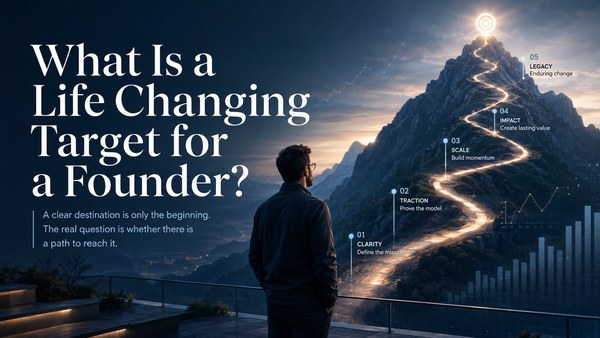
A Life Changing Target is the long-term business outcome a founder is building toward, paired with the plan, support system, funding pathway, and accountability needed to reach it.
For some founders, that target is financial independence.
For others, it is a meaningful exit.
For some, it is building a durable company that can create value for decades.
The target itself matters. But the harder question is not what you want to achieve.
It is how you are going to get there.
Many founders can describe the future they want. Fewer have the systems, support, capital access, strategic discipline, and accountability structure required to make that future realistic.
That distinction matters because building a company is hard, and sustaining one is even harder. According to the U.S. Bureau of Labor Statistics, only 34.7% of U.S. private-sector business establishments born in March 2013 were still operating in March 2023. The largest survival drop happened in the first year, when the rate fell by 20.4 percentage points.
Source: U.S. Bureau of Labor Statistics
A Life Changing Target is not just about ambition.It is about building the structure that gives ambition a real chance.
That is where Next Stage Trajectory begins.
Most founders are already working hard.They are selling, hiring, fundraising, managing customers,
solving problems, and carrying the emotional weight of growth. But effort alone does not create a trajectory.
A Life Changing Target forces a founder to define the real destination. It moves the conversation from
“we want to grow” to something more concrete:
That clarity matters because growth without direction can become exhausting.
Founders can win customers, raise money, expand the team, and still feel as if the
business is not moving toward the outcome they actually want.
The Life Changing Target creates a clearer frame. It gives the founder, the leadership team,
and the support network a shared outcome to work toward.
Scaling is not simply a bigger version of starting.
It requires a different level of structure.
The company needs stronger systems, clearer leadership, better decision-making,
more reliable funding pathways, stronger market access, and a team that can help the
founder move from doing everything to building something durable.
The ScaleUp Institute reported that the UK had 34,180 scaleup businesses in its 2024 analysis.
Those businesses represented half of all SME turnover output while making up less than 0.6% of the SME population.
Source: ScaleUp Institute, “Scaleups in the UK”
That statistic explains the opportunity and the challenge. Scaleups create outsized value.
But very few companies become true scaleups.
That is why founders need more than encouragement. They need a disciplined path.
Next Stage Trajectory was created to help ambitious companies reach serious scale through a
different model of founder support.
It is not a traditional accelerator.
It is not a peer networking club.
It is not a monthly coaching relationship.
And it is not vague advice from people who have never built, scaled, funded, or exited companies themselves.
Next Stage Trajectory was created by Bill Weathersby and a cohort of investors, entrepreneurs,
and business leaders to help founders turn growth ambition into a more structured journey.
The model combines strategic guidance, operating partner support, access to tools, funding pathways,
international expansion support, and regular accountability.
The purpose is simple:
Help founders define the Life Changing Target and then build the company capable of reaching it.
Next Stage begins by working with the founder to define a growth and exit plan.
For example, a company may be aiming to grow from £1 million in revenue to £40 million over a
defined period, often around 48 months.
That kind of target requires more than motivation.
It requires the right structure around the founder.
Next Stage supports founders through:
The difference is the cadence and the depth of support.
A seminar may last a day.
A coach may meet with a founder once a month.
An accelerator may end after a fixed programme.
Next Stage Trajectory works with founders on an ongoing basis, meeting regularly and
keeping the business focused on the growth plan.
The goal is not inspiration.
The goal is execution.
Founders do not usually fail because they lack ambition. They struggle because ambition
creates complexity. As the company grows, the founder faces more decisions, more pressure,
more opportunities, more risks, and more operational drag.
Without accountability, even strong founders can drift.
The weekly and biweekly rhythm of support helps keep the business aligned with the Life Changing Target.
It creates a structure where progress is reviewed, obstacles are identified, decisions are sharpened,
and the next steps remain connected to the larger outcome.
That accountability matters because a Life Changing Target is not achieved through one breakthrough
moment. It is achieved through repeated decisions that keep the company moving in the right direction.
Next StageTrajectory works with ambitious companies that are ready to scale and willing to challenge
the established players in their category. The current portfolio includes businesses across areas such as
agentic AI, legal technology, energy, and other growth sectors.
The common thread is not one specific industry.
The common thread is mindset.
Next Stage Trajectory is built for challenger companies with ambition, urgency, and a strong desire
to take meaningful market share.
These are often companies that have traction but need more structure, more support, more capital access,
or more experienced guidance to reach the next stage of growth.
They may not be the biggest company in the market.
They may not have been first.
But they have the hunger, differentiation, and determination required to build something significant.
Many scaling companies reach a difficult funding gap. They may need enough capital to unlock the
next stage of growth, but not so much that they fit neatly into the traditional venture capital or institutional funding model.
This is one of the most frustrating stages for founders.
The business may have traction.
The opportunity may be clear.
The next move may be obvious.
But the capital structure may not fit what traditional funders want to provide.
British Business Bank reported that the use of external finance by UK smaller businesses
rose from 41% in Q1 2024 to 50% in Q3 2024. The same report noted increased reliance on credit cards
and overdraft finance as business cashflows came under pressure.
Source: British Business Bank, Small Business Finance Markets Report 2024
That matters because founders do not only need money. They need the right kind of money,
at the right time, connected to the right growth plan.
Next StageTrajectory was designed with that gap in mind.
Alongside strategic support and international expansion guidance, Next Stage can provide funding
aligned with the lifecycle of a modern scaling business.
The model is structured so the founder can focus on building toward the Life Changing Target.
Next Stage is rewarded at the end of the process through a percentage of exit value, rather than
taking equity or classifying the funding as traditional debt.
For founders, that matters.
It creates a support model designed around shared outcome, not short-term extraction.
For many ambitious companies, the Life Changing Target will not be achieved in one market alone.
The company may need access to new customers, new partners, new investors, and new geographic opportunities.
International expansion can be powerful, but it also creates complexity. Founders have to navigate new buyer behavior, market dynamics, relationships, regulations, and operating expectations.
OECD research on scaling businesses found that across 17 OECD and accession countries,
about 38% of young SMEs become scalers, compared with 22% of mature SMEs. The OECD
also notes that knowledge-intensive SMEs are more likely to scale, including firms in advanced tradable services,
ICT, consultancy, and high- and medium-high-tech manufacturing.
Source: OECD, “Understanding scalers and the policies that support them”
For founders in high-growth sectors, the opportunity is real.
But so is the need for experienced support.
Next Stage Trajectory helps founders think beyond local growth and build a more intentional
path into the markets, networks, and relationships that can support the company’s next stage.
Next Stage tends to work well with two types of founders. The first is the founder
who has been building for several years but is not getting the traction the company deserves.
The product may be strong.
The team may be capable.
The opportunity may be real.
But the business needs access to better networks, better capital pathways, stronger market entry support,
or a more disciplined growth structure.
The second is the founder who is working nonstop and beginning to realize that one person cannot
raise money, sell, manage delivery, code, hire, expand, and lead the company alone.
That founder does not need more generic advice.
They need a team around them.
Next Stage Trajectory provides that support structure so the founder is not trying to
carry the entire growth journey alone.
A strong Life Changing Target should be ambitious enough to matter and specific enough to plan around.
It should answer questions like:
A target becomes more realistic when the founder can work backward from the future
and identify the steps, resources, and operating discipline needed to reach it.
That is the difference between a dream and a trajectory.
Founders can start by speaking with the Next Stage team to determine whether the model is a good fit.
Next Stage Trajectory also runs events across the United Kingdom, United States,
and other markets, giving founders the opportunity to meet the team, connect with operating partners,
and understand the support available.
The conversation is designed to be practical.
Where are you now?
Where are you trying to go?
What is standing in the way?
What would make the next stage of growth genuinely life changing?
If you are a founder with ambition, traction, and the desire to build something significant,
your Life Changing Target is worth defining.
But the target is only the beginning.
The real work is building the path to reach it.
A Life Changing Target is the long-term business outcome a founder wants to achieve, such as financial independence, a meaningful exit, major revenue growth, or building a durable company with lasting enterprise value.
A Life Changing Target gives the founder a clear destination. It helps align growth strategy, funding, operations, accountability, and decision-making around a specific future outcome.
The timeframe depends on the company, market, funding needs, and growth stage. Next Stage often frames the journey around a defined multi-year period, such as a 48-month growth path.
Many founders struggle because scaling requires different systems than starting. Growth creates pressure around leadership, funding, hiring, operations, market expansion, and accountability. Without structure, ambition can turn into complexity.
Accelerators usually run for a fixed period and often provide general programming. Next Stage provides ongoing support, regular accountability, operating partner guidance, funding pathways, and practical help tied to the founder’s specific growth and exit plan.
Next Stage can provide funding support for qualifying companies, particularly where founders need capital to unlock the next stage of growth.
According to the current model, Next Stage does not take traditional equity or classify its funding as debt. Instead, it is rewarded through a percentage of exit value at the end of the process.
Next Stage works with ambitious challenger companies across sectors such as AI, legal technology, energy, and other growth markets. The strongest fit is usually a founder-led company with traction, ambition, and the desire to scale.
The best first step is to speak with the Next Stage team. The conversation should help determine where your company is today, what your Life Changing Target looks like, and whether Next Stage can help you build the path to reach it.
U.S. Bureau of Labor Statistics, “34.7 percent of business establishments born in 2013 were still operating in 2023”
https://www.bls.gov/opub/ted/2024/34-7-percent-of-business-establishments-born-in-2013-were-still-operating-in-2023.htm
ScaleUp Institute, “Scaleups in the UK 2024”
https://www.scaleupinstitute.org.uk/wp-content/uploads/2024/07/Scaleups-in-the-UK-2024.pdf
British Business Bank, “Small Business Finance Markets Report 2024 – Factsheet”
https://www.british-business-bank.co.uk/about/research-and-publications/small-business-finance-markets-report-2024/factsheet
OECD, “Understanding scalers and the policies that support them”https://www.oecd.org/en/publications/unleashing-sme-potential-to-scale-up_ea948a58-en/full-report/understanding-scalers-and-the-policies-that-support-them_e7722972.html