
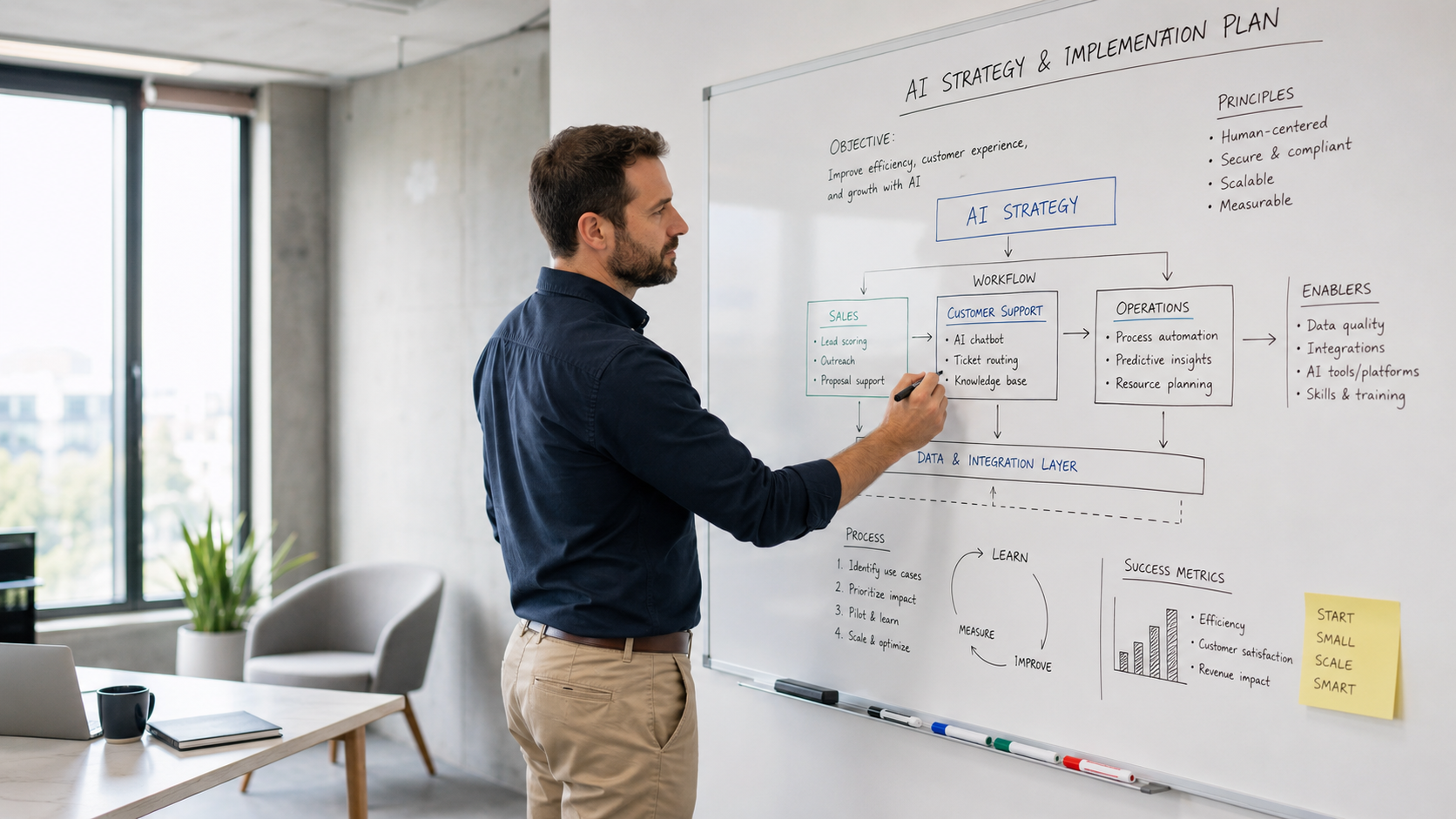
Artificial intelligence is becoming a practical business tool, but many companies still lack
the technical resources required to use it effectively.
In late September 2025, 23% of UK businesses reported using some form of AI technology, up from 9%
when the Office for National Statistics began tracking the question in September 2023. That growth shows
increasing demand, but it also means most businesses had not yet adopted AI.
Kritmatta was created to make that transition more accessible.
One of the latest companies to join Next Stage Trajectory, Kritmatta enables businesses to build AI agents without
writing code. Its platform is designed to automate parts of sales, customer support, and operations
while integrating with the tools a business already uses.
Kritmatta was founded by Kalpesh Baxi alongside his co-founders Duncan and Manjit.
Kalpesh’s career has largely focused on recruitment, staffing, and technology. He previously worked with
global staffing company S3 as it grew from approximately 230 employees to 3,000, surpassed $1 billion in turnover,
and became publicly listed. He later worked with SaaS start-ups and became an angel investor and board advisor.
That experience helped the founders recognize a growing challenge: businesses want to become more AI-native,
but many do not have software developers who can build the systems they need.
Kritmatta addresses that problem by allowing companies to create agents without writing code. Rather than requiring
a business to replace its existing technology, those agents can be connected to the tools and processes already in place.
This is particularly relevant because AI adoption remains uneven. Office for National Statistics research found that 9% of
UK firms had adopted AI in 2023, compared with 69% using cloud-based systems or applications. The research also
examined how management practices, skills, cost, and uncertainty influence adoption.
Kritmatta is focused on closing the distance between a business recognizing AI’s potential and actually being able to apply it.
Kritmatta’s purpose extends beyond automation.
Kalpesh and his co-founders want to make sure that businesses and individuals are not excluded from the opportunities
AI may create. Their goal is to make the technology easier to use for people who understand their work but
do not have specialist development skills.
The need for accessible technology is significant. The UK government’s Essential Digital Skills Framework
was created around the skills adults require to participate in and benefit from an increasingly digital society.
It covers areas including communicating, handling information, completing transactions, solving problems, and remaining safe online.
AI introduces another layer to that challenge. Employees may understand their customers, operations,
and responsibilities
without knowing how to code an automated system.
A sales leader understands when and how a prospect should receive a follow-up. A customer-service manager understands
which questions can be handled automatically and which require a person. An operations leader understands
where repetitive work creates delays.
Kritmatta is designed to place that practical knowledge closer to the development of the AI agent.
The platform does not remove the need for human oversight. It reduces the technical barrier preventing employees
from helping determine how AI should work within their company.
Kritmatta is being developed around the belief that AI should support people rather than simply replace them.
Current workplace research supports a more nuanced view of AI’s impact than the assumption that complete jobs
will immediately disappear. OECD case studies found that job reorganization has so far been more common than
job displacement. Automation often shifts employees toward tasks where human judgment,
communication, and experience remain more valuable.
The OECD has also found that many workers exposed to AI will not require specialist skills such as machine
learning or software engineering. However, the tasks they complete and the broader skills they
need are still likely to change.
That distinction closely reflects the opportunity Kritmatta is pursuing.
Its agents can handle defined parts of sales, support, and operations, but the people within those functions
still determine the goal, provide context, review results, and manage the relationships surrounding the work.
AI can complete a task. The business still needs people who understand why the task matters.
The long-term employment picture will remain complex. The World Economic Forum estimates that global
labor-market changes could create 170 million roles while displacing 92 million by 2030, resulting in a net increase of 78 million jobs.
For Kritmatta, this reinforces the importance of helping more people participate in that transition
rather than limiting useful AI tools to technical specialists.
Kritmatta’s founders have also taken a deliberate approach to building the company.
They bootstrapped the business for its first eighteen months because they wanted to remain focused on
product-market fit. Kalpesh believed that raising too much capital before validating the product could
distract the team from understanding what customers genuinely needed.
The company then progressed through several early milestones.
Kritmatta launched publicly in February, introduced paid access in March, completed a small raise through
a UK-based venture capital firm in April, and surpassed 100 website users in May.
This sequence reflects a disciplined approach to growth.
The founders did not begin with a large funding round and then search for a problem to solve.
They identified a need, developed proprietary technology, introduced the product, attracted users,
and raised capital to support sales and marketing.
That focus is especially important in a rapidly developing AI market. Growing adoption creates opportunity,
but it also produces more competition and more products making similar claims.
Kritmatta must demonstrate that its agents do more than introduce AI into a business. They must solve
defined problems and create practical value.
Kritmatta was introduced to Next Stage Trajectory through Daniella Goodwin, NST’s UK-based operating partner.
The relationship made sense because the United States is a future target market for Kritmatta and NST was
founded there. Kalpesh later met NST founder Bill Weathersby, who understood the company’s vision and
saw how the Next Stage approach could support it.
Kritmatta had already been approached by other accelerator programs. The founders declined because those
programs did not provide the comprehensive support or long-term commitment they were seeking.
They wanted more than short-term fundraising assistance.
The founders were looking for support with product-market fit, internal systems, customer acquisition,
market expansion, and the longer journey toward an eventual exit.
NST offered that wider relationship.
Bill and Daniella are helping the founders clarify where Kritmatta needs to go and break that direction into
monthly, weekly, and daily priorities. The work includes regular meetings, direct feedback, accountability,
potential customer introductions, and preparation for eventual entry into the US market.
Kalpesh has described the relationship as honest and dependable. The promised support has been delivered.
The relationship also gives Kritmatta a valuable environment in which to develop and test its platform.
Kritmatta is currently building the product for Bill. Once it is ready, the plan is to introduce it across the
wider Next Stage Trajectory portfolio.
This could give the company direct exposure to businesses with different sales, support, and operational requirements.
Instead of testing the platform only through demonstrations, Kritmatta can observe how companies use
its agents within real workflows. The founders can identify which features create the most value, where users
encounter difficulty, and how the product must adapt to different operating environments.
NST’s portfolio companies can also benefit from access to a no-code approach to AI automation.
The relationship is therefore not limited to investment or advice. The portfolio can become a source of users,
feedback, validation, and commercial opportunity.
For a young technology company, that access can be as important as capital.
Kritmatta has moved from a bootstrapped idea to a funded company with a live product and a growing user base.
Its next challenge is to turn that early momentum into a repeatable and scalable business.
With Next Stage Trajectory, the founders are refining the product, developing stronger operating systems,
increasing adoption, and preparing for future international growth. Another funding round may eventually
become part of that journey, but only when the business is ready.
The company’s approach reflects the technology it is building.
Kritmatta is not asking businesses to adopt AI simply because it is new. It is helping them identify practical
ways to use it within the work they already do.
The question is no longer whether AI will become part of business.
Kritmatta is helping companies answer the more important question: how?
Kritmatta enables businesses to build AI agents without writing code. The agents can support areas such
as sales, customer service, and operations while integrating with the company’s existing tools.
Kritmatta was founded by Kalpesh Baxi, Duncan, and Manjit. Kalpesh has a background in recruitment, staffing,
SaaS businesses, angel investing, and board advisory work.
No-code technology enables people with business and operational expertise to help create automated systems
without needing software-development skills. This may make practical AI adoption more accessible to smaller
businesses and nontechnical teams.
Kritmatta is developing proprietary technology that allows companies to create agents around specific workflows.
Its focus is on integrating AI into sales, support, and operational processes rather than providing only a general-purpose content tool.
The founders wanted comprehensive, long-term support rather than a temporary accelerator program. NST is
helping Kritmatta with product-market fit, execution, systems, customer introductions, portfolio access, and preparation for the US market.
The company plans to continue developing the product, increase its number of users, introduce the platform across
NST’s portfolio, and eventually enter the US market. The founders may consider another funding round when the timing is right.
Department for Education. “Essential Digital Skills Framework.” GOV.UK, September 12, 2018; updated April 23, 2019.
Next Stage Trajectory. “Kritmatta Founder Interview with Kalpesh Baxi.” Internal interview document supplied for this article.
Office for National Statistics. “Business Insights and Impact on the UK Economy: 2 October 2025.” October 2, 2025.
Office for National Statistics. “Management Practices and the Adoption of Technology and Artificial Intelligence in UK Firms: 2023.” March 24, 2025.
Organisation for Economic Co-operation and Development. “AI and Work.” OECD.
Organisation for Economic Co-operation and Development. “Artificial Intelligence and the Changing Demand for Skills in the Labour Market.” OECD Publishing, 2024.
Organisation for Economic Co-operation and Development. “The Impact of AI on the Workplace: Evidence from OECD Case Studies of AI Implementation.” OECD Publishing, 2023.
World Economic Forum. “Future of Jobs Report 2025.” January 2025.